


Chinese President Hu Jintao (胡錦濤) arrived yesterday in North Korea for a rare visit, with the six-nation talks on the regime's nuclear program expected to top the agenda. As Hu touched down at Pyongyang's airport, he was greeted by reclusive leader Kim Jong-il.
"The China-North Korean friendship ... is conducive to safeguarding peace and stability and promoting development and prosperity in the region," Hu was quoted as saying on arrival.
Hu's three-day mission will be to convince his hosts of the need to stick to commitments they made in nuclear talks in Beijing last month, and China's own stake in the game ensures that he will be speaking forcefully, analysts said.
"This is critical to China's image as a rising power and its credibility and ability in delivering results," said Yuan Jing-dong, an expert on Asian non-proliferation at California's Monterey Institute of International Studies.
"But most important, failure would completely rupture the six-party process, which in turn could lead to further deterioration of the peninsular and indeed Northeast Asian security situation," he said.
The next round of six-party talks involving the two Koreas, China, Japan, Russia and the US is expected in the Chinese capital next month.
At the last round of six-nation talks, North Korea agreed to a statement of principles that could potentially end the prolonged standoff. Under the principles, North Korea would give up its nuclear weapons program in return for energy and security guarantees.
But soon after agreeing to the statement, Pyongyang said it would not dismantle its nuclear arsenal before the US supplies it with a light-water atomic reactor to generate electricity. The US says North Korea, a self-avowed nuclear power, must first disarm before getting incentive bonuses, including the nuclear reactor.
The signs that the entire deal could yet unravel may put Hu in an awkward situation, as it is likely he only agreed to visit the impoverished country after it promised to be more forthcoming.
"The North Koreans have been trying to get Hu to make a reciprocal visit for over a year but he had held off until the six-party talks were resumed," said Ralph Cossa, president of Honolulu-based think tank Pacific Forum CSIS. "I assume this was part of the `incentives' that got Pyongyang back to the table and then got them to sign the statement in September."
If North Korea backpedals at the next round, it could trigger the rage even of China, arguably its oldest and most reliable ally.
"China's patience is running thin," Cossa said. "The risk to Hu in going is that if North Korea plays games at the next round in early November, it also discredits China's and Hu's personal diplomacy skills."
While in Pyongyang, Hu is expected to air the idea of economic reform to Kim, pointing out China's experience and hinting that he cannot expect to depend on China's largess forever.
Economic reform is widely considered the only way out for a country suffering from decades of mismanagement, but it is hard to implement with a man like Kim at the top, experts said.
"Kim is paranoid on potential threats to his own legitimacy and the regime's, so he will try to fend off the idea even though he will try not to offend Hu," Yuan said. "In the longer term, a reforming North Korea, even if with ginger steps initially, will work to China's interests."
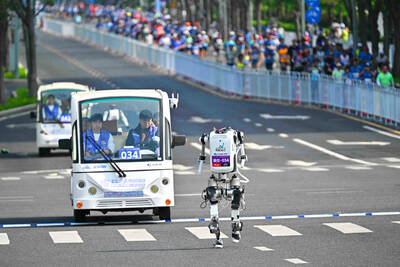
A humanoid robot that won a half-marathon race for robots in Beijing on Sunday ran faster than the human world record in a show of China’s technological leaps. The winner from Honor, a Chinese smartphone maker, completed the 21km race in 50 minutes and 26 seconds, said a WeChat post by the Beijing Economic-Technological Development Area, also known as Beijing E-Town, where the race began. That was faster than the human world record holder, Ugandan Jacob Kiplimo, who finished the same distance in about 57 minutes in March at the Lisbon road race. The performance by the robot marked a significant step forward
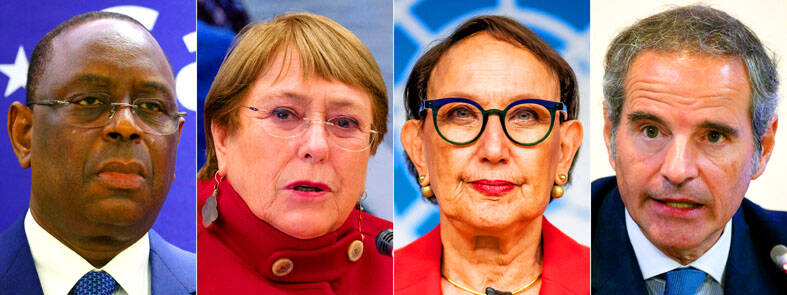
Four contenders are squaring up to succeed Antonio Guterres as secretary-general of the UN, which faces unprecedented global instability, wars and its own crushing budget crisis. Chile’s Michelle Bachelet, Argentina’s Rafael Grossi, Costa Rica’s Rebeca Grynspan and Senegal’s Macky Sall are each to face grillings by 193 member states and non-governmental organizations for three hours today and tomorrow. It is only the second time the UN has held a public question-and-answer, a format created in 2016 to boost transparency. Ultimately the five permanent members of the UN’s top body, the Security Council, hold the power, wielding vetoes over who leads the
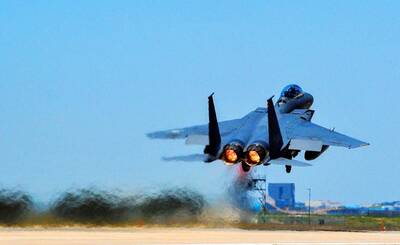
South Korea’s air force yesterday apologized for a 2021 midair collision involving two fighter jets, a day after auditors said the pilots were taking selfies and filming during the flight and held them responsible for the accident. “We sincerely apologize to the public for the concern caused by the accident that occurred in 2021,” an air force spokesman told a news conference, adding that one of the pilots involved had been suspended from flying duties, received severe disciplinary action and has since left the military. The apology followed a report released on Wednesday by the South Korean Board of Audit and Inspection,
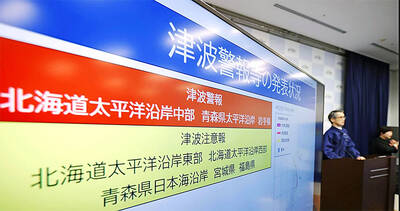
An earthquake registering a preliminary magnitude of 7.7 off northern Japan on Monday prompted a short-lived tsunami alert and the advisory of a higher risk of a possible mega-quake for coastal areas there. The Cabinet Office and the Japan Meteorological Agency said there was a 1% chance for a mega-quake, compared to a 0.1% chance during normal times, in the next week or so following the powerful quake near the Chishima and Japan trenches. Officials said the advisory was not a quake prediction but urged residents in 182 towns along the northeastern coasts to raise their preparedness while continuing their daily lives. Prime


 RSS
RSS